
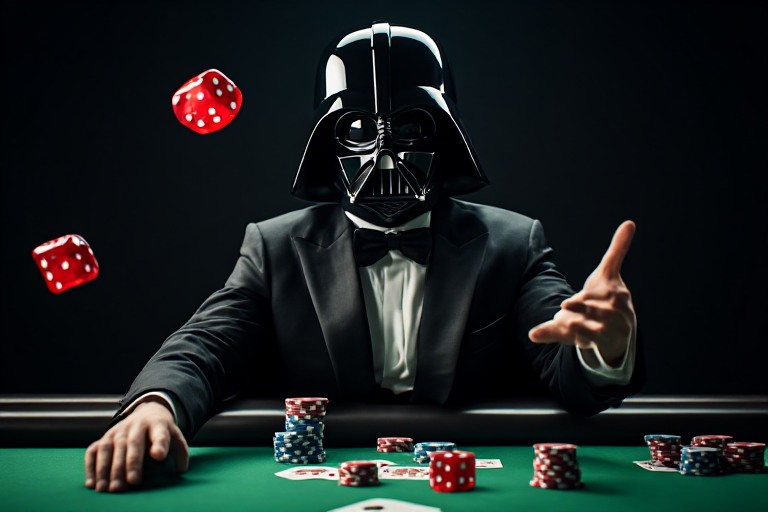
I am a firm believer that we humans need a little friction in our lives. We need stress. I talked about this a while back ( The Stress Vacuum: Why Retirement Won’t End Anxiety), but a recent conversation with my “guys group” reminded me of just how stupidly we behave when we look for that stress in all the wrong places.
One of the men in our group is an Economist. One night he started to talk gambling. With ads everywhere the modern landscape of gambling, from sports betting to slot machines apps on phones have stripped away every old-school barrier to gamble, like driving to a casino. It has never been easier to lose money.
Being schooled in math, he lives and breathes logic. He genuinely couldn’t wrap his head around why people gamble when the expected outcome is mathematical certainty that you will lose. “The house always wins.”
I had the answer for him. Because twenty-five years ago, unbeknownst to him, Vader was a gambling addict. And if I ever let my guard down, I could be one again tomorrow.
Gambling isn’t about logic. It’s about emotion. I was an addict to the emotions gambling created. Specifically, it’s about a warped need to feel strong emotions which stress is one.
The Trapping of the Death Star
Twenty-five years ago, a tech startup I was with was going bust. The founders and senior executives had already jumped ship, leaving us with exactly two months of cash to pay salaries before the doors locked for good.
It was a fascinating psychological study watching how people reacted to certain doom. Some worked harder than ever. Some denied the end with every fiber of their being. Some just goofed off. Most people showed up at 9:00 AM and slipped out by early afternoon.
How did Vader handle the slow-burn dread of a dying company? I was trapped in a state of passive, helpless stress. To counter it, I got to work at 9:00 AM, and at exactly 2:00 PM every single weekday, I left for the casino.
Sowing the Seed: From Vegas to Baccarat
My only prior exposure to gambling had been a single, exhaustion-fueled night in Las Vegas. We were there as we were coming back from hiking the Grand Canyon. All my friends were calling it a night as we were exhausted from a 4 day hike sleeping in tents. But Vader was young, in Vegas 1 night only with enough money burning a hole in his pocket, hit the casino floor.
I am also a math guy. I know the odds in gambling are poor. So what did I do? I found the Roulette table at 10 pm with a $200 stake that I was willing to lose. Even as a math guy, I wanted to see how long a $200 stake could survive using a simple doubling-down strategy on a $2 Roulette table. Eight hours later, after riding that $200 all the way up to $1,800, I finally hit a seven-time losing streak and busted. If it had gone 1 hour longer I would have been on a plane with a smile on my face.
It was a fantastic one-time entertainment cost. But Vegas had planted a seed. And a couple of years later, a friend was about to water it at our local casino.
He had a “system” for Baccarat—the James Bond game—based on an $800 bankroll. It was an aggressive, tripling-down progression: $25, $75, $175, $375, to whatever was left. The odds of winning a hand were roughly 48% (the same as red or black in roulette), and the goal was simply to net $25 a hand.
The worst possible thing happened to me that first night.
I won.
We played one “shoe” (about 50 hands of cards), which took maybe 30 minutes. My friend hit a losing streak and wiped out his $800. I walked away with $1,200. My friend seeing me win wanted to redeem himself. We went back two nights later; he lost another $800, and I won another $1,200.
My friend walked away forever cured.. I was utterly hooked.
Payouts in Cortisol
My economist friend wonders why people gamble when the expected value is negative. It’s because he is calculating the payout in dollars, while the gambler is unconsciously calculating the payout in dopamine and cortisol.
When you push $500 into the circle, your heart rate spikes, your focus narrows, and the world goes quiet. For an addict, that hyper-focused state is the prize. The instant stress and euphoria is what you chasing. Winning is just the permission slip to keep playing.
For two months, that 2:00 PM casino run became my daily fix. I sat with the same group of regulars every day, all addicts, all of us trapped in the same loop. I would play exactly one shoe of cards. Either I would lose my $800 daily limit, or I would win $1,200.
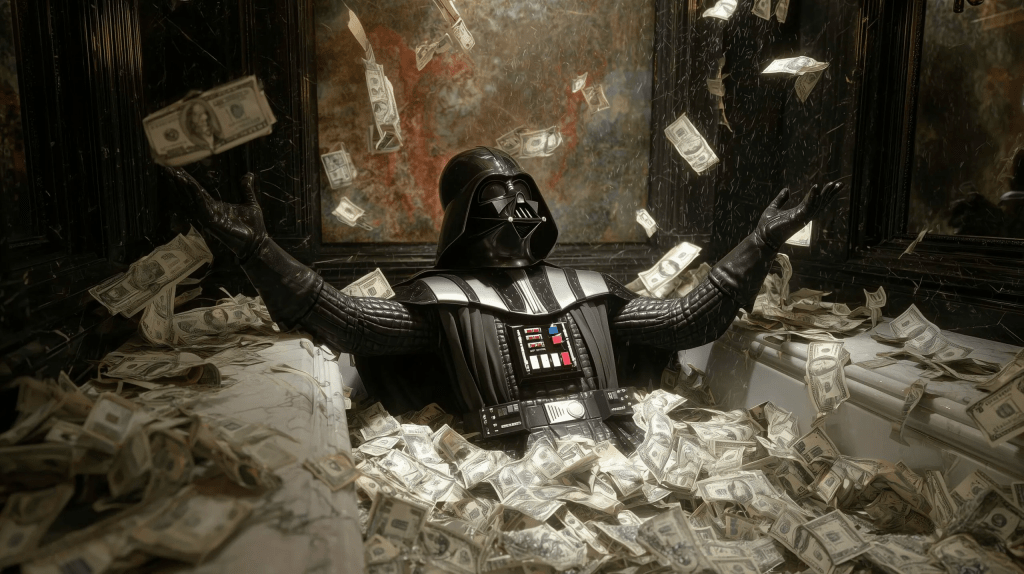
The logic side of my brain told me it was fine because I was playing with “house money”—the original $2,400 windfall. My bankroll surged up to +$11,000 at one point, crashed back down to +$2,000. I never went below zero, so I told myself I was safe. I kept the winnings in cold, hard cash. At one point, my girlfriend took the stack of bills, threw them into the air, and did a dance as they rained down around the living room. (Funny enough, I found a stray $100 bill still wedged into the baseboard a month later).
How the Math Won
How did it end for Vader?
The day the startup officially declared bankruptcy and closed its doors was the exact day I stopped. With no income coming in, the logic gates in my brain finally slammed shut. The math guy overrode the addict. I knew the odds. I watched my friend lose. I knew the runway was finite, and I walked away with a net profit of $8,000.
But the real victory wasn’t the cash; it was the self-awareness. Knowing that the “addict” is still in there, just waiting for the guard to drop, is exactly what keeps the “disciplined investor” safe today
In the 20-plus years since, I have only gambled a handful of times at social events. Every single time, that old rush wakes up instantly. I know how easily I could fall right back into a daily rhythm. That rush is a drug. That’s why I choose not to play. I like it too much.
The Lesson for the Retirement Horizon
When I finished telling this story, my guys group was quiet. They know my current financial situation, and they couldn’t reconcile the disciplined investor they see today with the guy chasing a Baccarat rush to escape a dying startup.
But the lesson is incredibly relevant as I look toward the horizon of retirement.
When you remove the natural friction and stress of a career, your brain doesn’t suddenly stop wanting stimulation. If you don’t find a healthy source of stress, your mind will manufacture an unhealthy one. People who fail to plan for this end up day-trading risky options on their phones, obsessing over the 24-hour news cycle, or picking fights over nothing just to feel the strong emotions.
As we invest in a market sitting at all-time highs, the temptation to tweak, overreach, or chase a narrative is always there. That’s just the Dark Side looking for a hit of stress.
Don’t look for it. Because if you look for it, you will find it.
If you are approaching retirement or are already there, you have enough. Don’t stress about it, and please don’t gamble it—whether at a casino or on some insane stock market bet. Diversify. Be conservative. Don’t overreach. Have a 10-year plan.
Go find your healthy stress. Whether that’s a grueling hike, learning a brutally hard new skill, or mentoring a new startup (from a safe distance!).
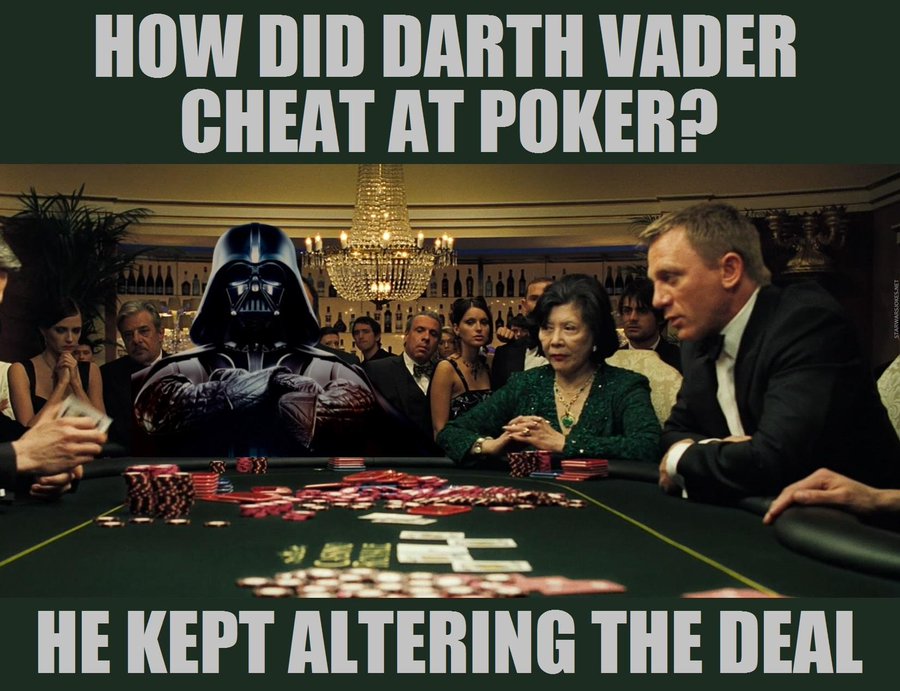
Leave the Baccarat to James Bond.




Leave a Reply