

In my 50s, my brain still likes to think it’s in its 20s. But let’s face it, there’s some mileage on the chassis now, and the body rears its head every so often to remind me.
Take my knee, for example. It greets me with a dull ache after too much exercise—and by “too much,” I mean walking more than seven kilometers or attempting a light run. The prescription is simple: strengthen the surrounding muscles and stick to a daily stretching routine. I’m actively trying the first, and I desperately need to work on the second.
But there is another health issue creeping up that worries me a bit (and worries Padme a lot). My short-term memory is noticeably worse than it was a few years ago.
At first, I blamed it on the “husband shield.” I just assumed I was half-listening to Padme—deploying the defensive perimeter where only a fraction of the incoming data gets through. I figured because I wasn’t fully engaged, the info simply wasn’t being filed appropriately.
Lately, though, I’ve seen signs that it isn’t just the shield.
We’ve all done it. Walking into a room to get something and entirely forgetting why we are there. Or struggling to remember what we did yesterday. Worse, I can have a great conversation with a friend in the morning, only to find myself trying to tell them the exact same story in the afternoon.
My long-term memory seems fine, but the short-term stuff is getting wonky.

So, I started poking around the research to see if it’s just me, or a standard part of aging.
The results? Mild, gradual declines in working memory—the mental workspace we use to temporarily hold and manipulate info—are a standard part of biological aging. It actually begins imperceptibly in our 30s and 40s, but the brain easily compensates so we don’t notice it. By the time a man hits his 50s, it becomes consciously noticeable.
Okay, I’m mid-50s. Crap. Strike 1. It turns out I am officially stupider than I was in my 20s. But at least I’m normal.
I used to be the guy who never took notes. I didn’t need to. Writing things down in a notebook felt like a waste of time because I’d never read them anyway. I took pride in holding everything in the RAM and accessing it instantly. It’s part of the reason I thought I could make better decisions than most; the processor was fast, the info was right there, and big-picture thinking came naturally.
Cognitive research shows that peak processing speed maxes out in your 20s. For me, my brainpower definitely felt awesomer back then. But over the last decade, the system changed. I don’t process information and store it for quick access anymore; it just fades away. Maybe the memory banks are full.
Today, my decisions rely on the hard drive—the long-term memory bank. I decide based on previous experience. The choices are still good, but I’m likely not considering new information enough. The processor doesn’t engage because it doesn’t have to. Wash, rinse, repeat. No new thinking. I have the brain turned off, and even in a work fog, I do the right things in my role.
So, is this memory decline purely age-related, or am I doing it to myself?
I have talked many times about how work is not that hard anymore. When work drops into low gear, does the brain naturally shift into power-saver mode? Is my overall lack of engagement at work spilling over into the rest of life and impacting my memory?
Both the “husband shield” and the “work fog” are symptoms of passive listening. Because my brain isn’t being forced to do anything with the information, it discards it before it ever hits the hard drive. Because my decisions are based strictly on long-term memories—and the passive husband shield allows Padme to make all the short-term calls around the house—I’ve effectively powered down this part of my brain.
Can I get it back, or is it truly a case of “use it or lose it”?
Being engaged in any work helps mental aging. Studies show that a demanding professional career forces you to constantly adapt to unpredictable variables like managing a project, solving a technical breakdown, or navigating a crisis. This constant mental juggling is a workout for your prefrontal cortex, building the “muscle.”
Without those novel challenges, the mental muscles soften, and the brain simply trims away underutilized synaptic connections.
Strike 2. Disengagement is bad; synaptic connections are dying. Holy $%$#@
So now I am worried about retiring. The real danger zone appears when you leave the office for good as the built-in structure of a career vanishes. Without that automatic daily anchor, routine dissolves. Any day to day challenges decrease. Mental pushups stop in a way.
Processing speed slows down because there is no clock to race, and the days may begin to blur into one long weekend. When every day feels identical, your short-term memory loses its timestamps, making it nearly impossible to pin down specific events.
Soon to be Strike 3. Suddenly, I’m a lot less worried about my knee. I have been disengaging from work frankly since Covid. I am seeing signs of short term memory issues already. And now I am going to be taking away more mental stimulation.
So, am I doomed to mental atrophy from a boring job and an upcoming retirement?
Maybe what used to be automatic just isn’t anymore. Maybe I need to ditch the automatic transmission, switch to manual, and engage the clutch to force myself to pay attention. I need to pick something—anything—new to learn. It’s a choice.
When a joint goes bad, we do targeted exercises, see a physiotherapist, and slowly rebuild capability. What do we do to rehab the mental part?
The good news is that the acceleration of memory decline in retirement isn’t permanent or inevitable. It’s driven by a lack of environmental demand, not an accelerated physical decay of brain tissue. If you replace the complexity of your career with new, self-directed challenges, you can flatten the curve entirely.
So, the scorecard I’ve set up for myself—the one where I commit to trying new hobbies, meeting new people, and being more social—takes on a whole new level of importance as I slide toward retirement
This isn’t an unfixable hardware failure; it’s a software optimization problem. It really is use it or lose it time. Time to download some new programs. Engage the clutch, Vader. Learn to write, try to be funny, and lean into the challenge. Brain exercises are just as important as leg day.
Time to go watch Jeopardy!
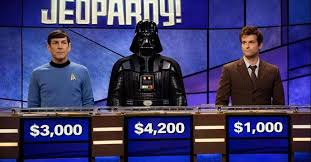
I’ll take competitors I have killed for 400, Alex







Leave a Reply