
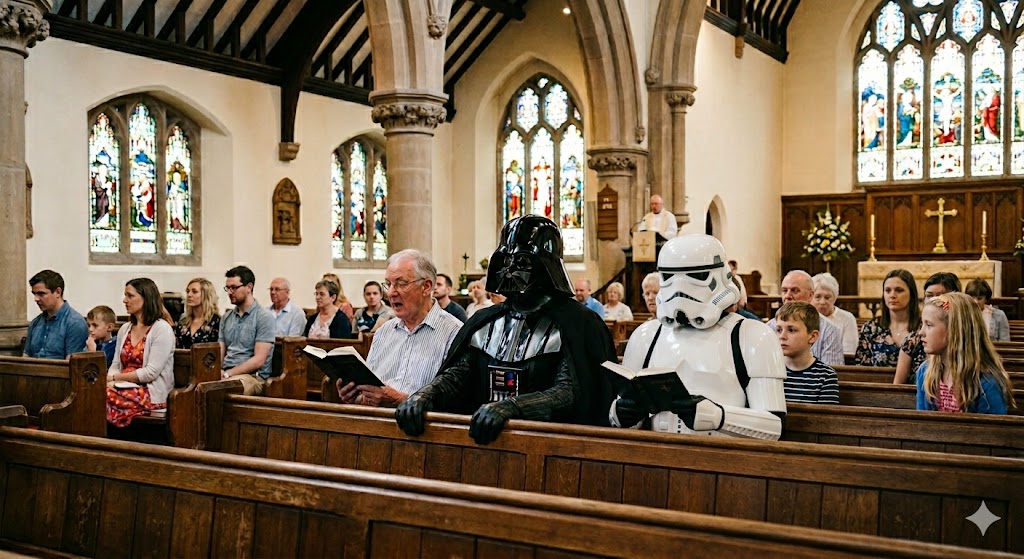
For the last six or seven years, I have been part of a friend group that I met through our local church.
Church has a way of providing a broader perspective on life and community. It gets me out of my own head and forces me to think of others and that genuine sense of connection is exactly what keeps me coming back.
The one beautiful constant it has provided is a small group of seven couples that gathers three to four times a month. We alternate: one week it’s just the guys, the next week the girls, and then we all gather together. Over the years, we’ve grown incredibly close, developing a fantastic, fun dynamic. Socializing is a massive pillar of a successful retirement, and building this circle completely outside of work is one of my personal wins.
While we are all married with kids, what makes the group unique is the spread in our stages of life. Some couples are in their 30s, most are spread across their early 40s, and then there’s us, sitting comfortably in our early 50s.
That age gap is a gift. It serves as a living mirror, allowing me to look back and remember every distinct season of parenting. I get to witness how people deal with the exhausting baby stage, the chaotic daycare years, and the beautifully socially awkward teenager phase. When your own kids grow up, it’s remarkably easy to forget just how all-consuming those younger years were, swallowing every ounce of your free time.
During our get-together this week, the conversation drifted into the standard rhythms of mid-life: paying off a car, navigating mortgage renewals, planning the next vacation, and booking kids’ summer camps.
As I listened, I sat back and quietly reflected on the different stages of our financial lives. It flooded me with an overwhelming sense of gratitude for where Padme and I are today—and specifically, for the distinct kind of stress we don’t have.
Most of the group’s anxiety centered around money and debt. Every couple is on the traditional, slow-and-steady path of clearing their liabilities right at the finish line of retirement, or maybe a few years prior. I was quietly fascinated by the discussion because it’s a reality I haven’t had to actively think about in a very long time.
It took me on a mental trip through our own good fortune. It is incredibly easy to forget the day-to-day grind of the money-struggle stage once it’s in your rearview mirror. For us, that stage was left behind a lifetime ago.
Consider vehicles: we haven’t had a car payment since I met Padme over twenty years ago. Our strategy has always been simple: buy a sensible vehicle (new or slightly used), pay cash, and drive it until the rust shows, the mechanical issues mount, or it physically refuses to go any further. Like the time a rogue tree fell directly on my van and crushed it.

I don’t think touch up paint will fix it this time
We’ve been exceptionally lucky with our rides, and they typically occupy our driveway for a solid decade. Paying cash when interest rates were hovering near zero percent might not have been the mathematically optimal move on paper, but I have an inherent aversion to payments. It’s a psychological trait I almost certainly inherited from my parents.
Our housing journey followed a similar, aggressive pattern. Twenty-five years ago, right during the peak of the dot-com bubble, I used an inheritance to buy a cottage outright. Looking back, it was the only good investment decision I made during that wild market era. When I met Padme, she had already bought a fixer-upper for next to nothing. Over a few years, she poured sweat equity into it and made it respectable. When we finally decided to relocate to the city we call home today, she sold it for nearly double what she paid.
That gave us serious leverage. When we bought our current home, we were able to put down a 40% down payment. We began attacking the remaining mortgage aggressively, aiming to erase it within five years instead of twenty-five.
Then, just three years into that plan, the unexpected happened: I was laid off from my high-tech job.
I was freshly unemployed, holding a severance package, right as our very first little JEDI was born. At the time, we were both earning good, but certainly not extravagant, salaries.
We took a hard look at the severance package and noticed a beautiful loophole in our mortgage terms. Our bank allowed us to put up to 10% against the principal once a year, but nowhere in the fine print did it say we couldn’t simultaneously triple our bi-weekly payments. We threw the severance into that loophole and completely obliterated the remaining balance in six short months.
Looking back, it probably sounds counterintuitive, if not downright crazy, that my very first instinct upon losing my job was to completely drain my liquidity to pay off a mortgage. Usually, you make a massive financial commitment like that when your income is secure, not when you’re looking for work.
But we officially became mortgage-free in 2008, right as the Great Financial Crisis was tearing through the global economy.
Now that’s done I might need to build a 2nd one some day
Our timing could not have been more accidental, or more perfect. Because we had been funneling every spare dollar into bricks and mortar rather than the stock market, the brutal downturn between 2008 and 2013 didn’t touch our minimal investments. By the time I landed my next role and we had excess cash to invest, the market was hitting rock bottom. We caught the elevator on the way up.
Sometimes in life, it is simply better to be lucky than good.
We became entirely debt-free sixteen years ago. I was 38; Padme was 33. We haven’t owed a dime to anyone since. In fact, it was so long ago that I actually had to look up my old career timeline just to verify the exact year. We held a mortgage on our house for a grand total of three and a half years.
It would be a fascinating exercise to calculate the exact mountain of interest we saved by avoiding the typical 25- or 30-year amortization schedule. Most people end up paying for two or more houses by the time the bank takes its cut; we managed to buy our home for the price of the sticker plus a tiny sliver of interest.
I am profoundly grateful that Padme and I share this exact psychological alignment. Our shared paranoia about debt is the precise reason we are able to have early retirement conversations today. We simply wouldn’t be here without it.
I’m also grateful for the contrast our friends provide. While it feels a bit surreal to sit quietly and listen to peers talk about car loans and amortization tables, it forces a healthy dose of perspective. It makes me deeply appreciate the position we’ve carved out. Our close friends know our situation, and it cracks me up that they occasionally use us as a financial sounding board—asking themselves, “What would Vader and Padme do?”
The very next day, I grabbed a beer with an old friend. He’s 62 and was caught in a corporate layoff a few months back. Over their working lives, he and his wife navigated the world on one strong professional salary and one average income. Two years ago, they decided to purchase a recreational property, leaving him holding a very healthy, very fresh mortgage.
Because of that debt, he was forced to jump straight back into the workforce, accepting a new role at a 33% pay cut just to keep up with the bank payments. It is not an easy job market out there when you are 62.
At the end of the day, all of these couples are just living the standard, culturally prescribed script: take on debt, buy the lifestyle, and chip away at it over a lifetime. Our compressed, debt-averse approach was entirely atypical. We are the oddballs.
If you are reading a blog like this, you are almost certainly one of those oddballs, too. The FIRE crowd is definitively not normal compared to the baseline population. As I’ve gotten older, I’ve not only come to accept that reality—I embrace it. We find a path to walk away from the corporate machine early by watching our spending, earning a strong wage, and aggressively investing the gap. We all do it in our own beautifully weird way.
So today, I am pausing to be thankful for a run of good fortune, a shared vision with Padme, and the FIRE path.
Because ultimately, that baseline of financial independence doesn’t just buy security—it buys options.

Now that is a retirement present – Padme what do you think? Please








Leave a Reply