
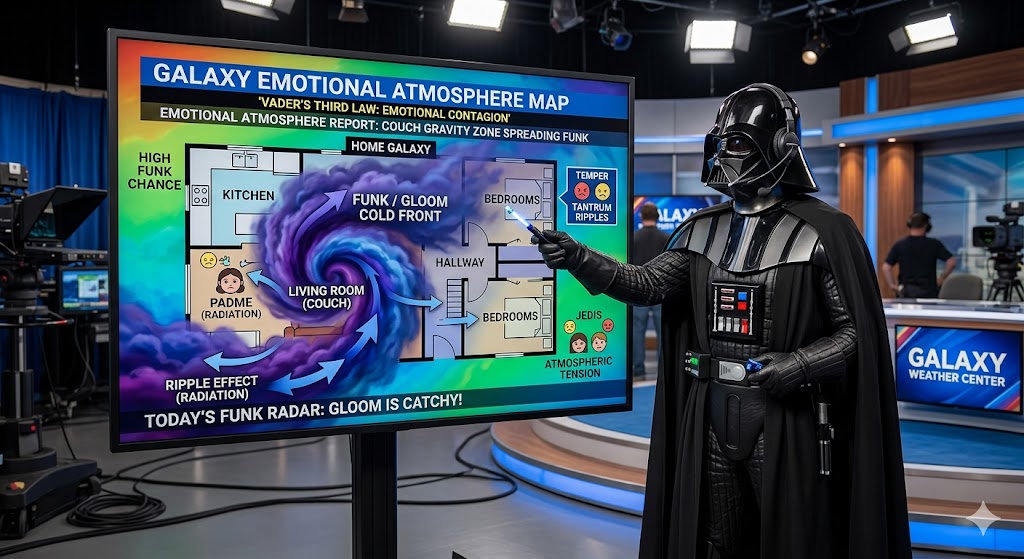
In my first article, (Vader’s First Law of eMotion: The Law of Emotional Inertia), I talked about Inertia—how a retiree at rest (on the couch, in a routine, or in a mood) tends to stay at rest. I suffer from this first law. I would be the opposite of what you call a self-starter. Retirement scares the crap out of me (and Padme for me) as I could easily get sucked into the gravity of the couch.
In the Second Law (Vader’s Second Law of eMotion: The Law of Emotional Mass), I talked about the size of your mood or your routine. If I am down in the dumps emotionally, it takes a lot to change my mood. The size of the action or the force to break my mood has to be proportional to my mood.
That brings us to our Third Law. In the science world, Newton’s Third Law of Motion states that for every action, there is an equal and opposite reaction. What this means is that when I push on a wall, the wall pushes back against me the exact same amount. Otherwise, one of us would fall over. Which brings us to:
Vader’s Third Law of eMotion — The Law of Emotional Contagion.
For every emotion (positive or negative), you create an emotional reaction in the people around you of that same emotion.
The Invisible Broadcast
An easier way to say it is if I snap at Padme or at my boss, I expect they will snap back at me. If I smile or am playful, they are happy and playful right back. If I grunt single syllables at them, I am going to change their mood to make them angry back in my general direction.
I always thought emotions were like a wave. They emanate out from you. Even if you are quiet and think you are hiding it, people can tell. They can feel it. Like a force. And it affects them. It changes the people around you. It’s like a game of emotional tag. If I’m miserable, I’m “it,” and I’m going to pass that gloom onto the next person I touch. I used to think my moods were private and didn’t affect anyone else.
But you can’t hide what you are feeling. Emotions transmit. You’ve felt this before: walking into a room and realizing you could “cut the tension with a knife” before a single word is even spoken.
Even without interacting, you feel how others are feeling. Body posture, facial tension, shallow breathing—these are all signals that you send and receive unconsciously. Evolution has made it so we can realize danger or friendship to help us survive.
That’s the Third Law. People are “broadcasting” their internal weather or emotion onto everyone around them.
The Reinforcement Loop
We aren’t just transferring our mood; this mood “transfer” ties back into the first two laws. It helps reinforce the mood you are in so you stay “at rest” in that same state. If I am grumpy and I make Padme grumpy, her reaction justifies my grumpiness. It increases the “mass” of that mood, making it even harder to change.
If I want to change the “weather system” of my bad mood, I need to change my thought patterns. I have to realize I’m not a thermometer, just reading the temperature or the mood of the room.
I need to be the thermostat. A thermometer just tells you it’s cold; a thermostat is the thing that actually changes the temperature. I consciously have to take an action to change my mood so it does not affect others.
Fake it to you make it actually works.
If I wait until I feel like being cheerful to change the energy in the room, it likely won’t happen. By the time my internal weather clears on its own, I’ve already infected the entire house with my gloom. Instead, I choose to “act as if” I’m the person I want to be. I put on the smile, I start the project, or I offer the hug before the impulse is even there.
This deliberate broadcast forces a positive reaction from the people around me, and suddenly, their “equal and opposite” response creates the very mood I was pretending to have. I’m no longer faking it; I’ve successfully engineered a new reality.
Becoming the Difference
- Own the Emotional Broadcast: Realize that your silence speaks. If you’re sitting there like a black hole, you’re sucking the energy out of the room. Simply acknowledging it—“I’m in a bit of a funk and I don’t want it to rub off on you”—breaks the spell. It stops the leak.
- The Pattern Interrupt: When you feel the house getting heavy, do something “off-script.” Most of the time, the people around you are just waiting for permission to be happy. If you crack a joke, open the curtains, or put on some music, you aren’t just helping yourself; you’re clearing the fog for everyone else.
- The “Lead” Energy: Don’t wait to see what the “vibe” of the house is before deciding how to feel. Set the temperature or frequency yourself. If you want a fun, high-energy retirement, you have to be the one to radiate that energy first.
The New Laws of the House
The Law of Emotional Inertia : A person at rest will stay at rest until an external event acts to change his emotion or mood.
The Law of Emotional Mass: The “Force” required to change your mood is directly proportional to the “Mass” or size of the funk you are in.
The Law of Emotional Contagion: For every emotion (positive or negative), you create an emotional reaction in the people around you of that same emotion.
Mastering these three laws in emotion is the difference between a life that feels like a slow slide into the upholstery and one that actually feels like living. You have to fight the inertia of the routine, put in the real work to move the big funks, and—most importantly—realize that your internal weather is a public event. People around you feel what you feel.
By owning my “radiation,” I stop being a passenger in my own house and start setting the tone for the life I actually want to lead. Every time I choose to be the thermostat instead of the thermometer, I’m changing the atmosphere that Padme and my little JEDIs are feeling.
If you understand these three laws, you won’t just survive the “Sunk in the Funk” phases—you’ll actually manage your environment instead of being a victim of it. Just don’t sit down for too long after dinner. The couch is a high-gravity environment, and the Third Law ensures you won’t be the only one stuck there.

No fighting – there are couches enough for both of us





 vaderonfire.com
Leave a reply to VaderonFire Cancel reply