
I have admitted to floating toward the dark side at times—and by that, I mean small “d” depression. I can see the dark side of things when maybe it’s not so bad. Some of the reason is due to my career experiences, but there is a part of it due to my underlying nature also. I like to think my “software” is coded for logic processing, but the “hardware” has some emotional buggy components that occasionally try to take over.
As a couple, I have leaned heavily on Padme because she is the opposite. She has always been on the other side of the equation: the positive force, the social anchor, the person people gravitate toward like moths to a porch light. Her software is built for emotional processing, underpinned by a massive amount of logic hardcoded into the system.
She has extremely high EQ. In layman’s terms, she is exceptionally good at dealing with emotions. This is invaluable when dealing with humans; she reads them well and uses her powers of EQ for the power of good.

The Cost of Emotional Labor
But lately, that high-level processing has come with a price.
Before the world shifted in 2020, Padme was energized by people. She didn’t just tolerate the office; she required it. That “work team closeness,” the feeling of being “all in this together” in the trenches of a large bureaucracy, was her fuel. She was the one who could walk into a room and bring people together just by being present.
But somewhere in the last three years, the polarity of that battery reversed. Being around people stopped being an addition; it became a drain, a subtraction.
We can look back now and see when this reversal began. It might have started in COVID we were trained to no longer be in person. It might have started when she applied for an internal role she truly wanted—a position that matched her skill set perfectly—and didn’t get it. It might have been the departure of her old boss, a mentor she trusted, which left her with less support.
Or perhaps it was the sheer, brutal volume of hours required as part of the COVID-19 relief programs. Working for the government during a global crisis means being in the “hot seat” for years on end, managing the emotions of a frustrated public and a stressed-out workforce. When COVID was over, her pace never came back to normal.
Then came the shift in leadership styles—the “New Boss” whose frequency didn’t align with hers—and the realization that her department was entering another massive transition period. For Padme, work has been a state of constant, high-velocity change for a decade, but the intensity since 2020 has been next level.
Hardware vs. Software
She is burnt out. It’s a reality that we are only now realizing.
The hardware still works. She can still attend the meetings, she can still write the briefing notes, and she can still lead the teams. This is the danger of being a high-performer: the exterior shell remains intact long after the internal systems have begun to fail. Because she is so skilled at managing other people’s emotional states, she has used those same “powers” to mask her own depletion. Because of her abilities the burnout is practically invisible.
I didn’t notice until looking backwards with the right filter.
I watched her roll with the punches for years, assuming she would always come out on top. But the swings are becoming too large to ignore. The emotional state can now flip from despair to “everything is fine” within a single day. Previously, a transition like that would have taken a week to process. When the software starts glitching this hard, it doesn’t matter how fast the processor is—the output is corrupted.
The “T-Minus” Recalibration
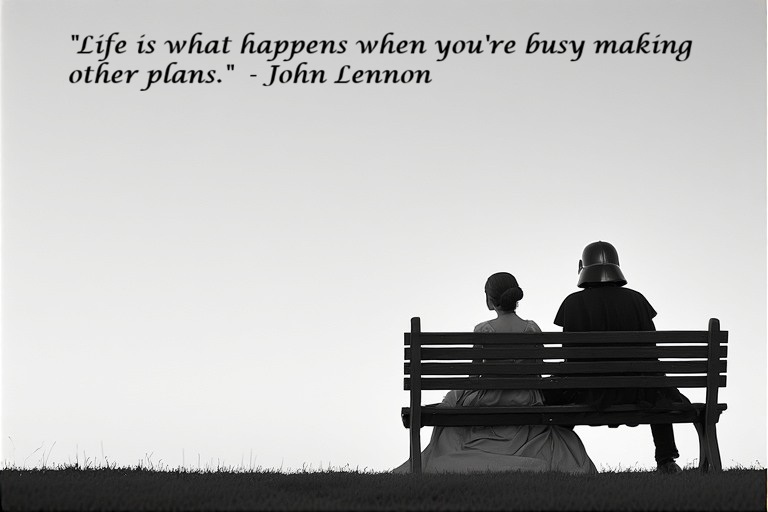
I feel like an ass for the “Part 1” post where I was focused almost exclusively on the math of the exit. My logic-coded software was looking at spreadsheets, safe withdrawal rates, and “T-minus” countdowns. But as the saying goes, “Life is what happens to you while you’re busy making other plans.”
In the FIRE (Financial Independence, Retire Early) community, we talk a lot about “the number.” We treat retirement like a destination we reach once we cross the goal line. But what good is reaching the destination if it breaks us in the process? It should never be about the money; it should be about the life the money is supposed to support.
So, we are taking the countdown off the launch pad. The “T-5” or “T-4” updates are irrelevant when systems are redlining.
Padme is going to take a much-needed break—at least one month, likely more. There will be a lot of life reflection, and truthfully, she will consider not going back to the same work. It really depends on how she feels after an extended break.
The questions we have can only be answered with time, and time is the one luxury our “financial independence” was supposed to grant us. We’re going to use it.







 vaderonfire.com
Leave a reply to Tech Cancel reply