
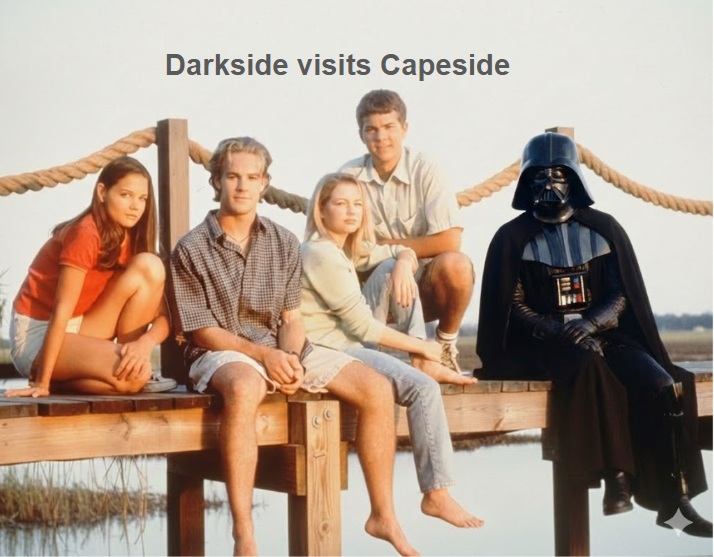
I was a big fan of Dawson’s Creek when it came out. I was 27 at the time, so I wasn’t exactly the target audience, but it always pulled me in. With James Van Der Beek’s recent death, I’ve been thinking back to the show and trying to understand why it was one of my favorites.
Growing up, I was always one of those quiet guys who would be described as reserved. We all go through the same emotions in life; it’s just that some are better at processing and showing them. I think our family dynamics have a lot of influence on how we deal with or display our emotions. More nurture than nature.
I would say that in my family, I was raised quite British (or maybe Vulcan). “Making a scene” was the last thing kids wanted to do. Showing most deep emotions is, by definition, “making a scene.” My parents and grandparents grew up in a time when keeping emotions in check was a way to get through tough times.
Showing emotion was seen as a sign of weakness or, worse, “bad form.” To be a “proper” adult meant being a rock for others. Emotions were suppressed in my house ; it somehow made it easier to get by. If you did not admit to feelings, you didn’t need to deal with feelings.
We all go through first crushes, first loves, and regrets over what we didn’t do when we had the chance. We think of the people we secretly liked, the people we were too scared to talk to, and so on. We all had our own Joey or Jen, Dawson or Pacey. Our feelings were just hidden and buried deep. As teenagers, we didn’t know how to deal with them.
I was really good at not dealing with emotions. I was really good at not taking a chance.
I think that is why Dawson’s Creek pulled me and millions of people in so hard. Here was a show of attractive teenagers who were perfect. They had such strong emotions, and they were able to—gasp—verbalize them perfectly. The show was built on the tension of the unsaid finally being said.
These are all the things that never happen in the real world. We didn’t love the show because we thought teenagers actually talked like that; we loved it because we wished we could. They acted as a stand-in for our own stifled emotions.
Here was a show of 16-year-olds talking like a team of 40-year-old philosophy majors with only a year left to live. On top of that, they were directed to act out every nuance of their internal worlds—and they had more than one take to get it right. Dawson’s Creek gave a sophisticated, poetic voice to the messy, internal “static” that most of us were too shy, or too repressed, to express in our own lives.
I guarantee you that if Vader (me) ever gave a Dawson Leery speech to a girl, she would be running away in terror or rolling on the floor in laughter. At least, that is how a typical 16-year-old would likely react.
But we all feel strong feelings when we are teenagers—ones we don’t know how to deal with. The emotions may not have been as mature or as intense as a TV show, but they were real. At one time, most of us were in love with being “in” love. It was a natural step of growing up.
Dawson’s Creek put words around those feelings perfectly. And the show explored the inevitable: the “I like you, but you like someone else” heartbreak; the exciting new girl in town; the nice girl falling for the screwup boy. It was a team of brilliant writers providing deep feelings for beautiful teenagers every week.
I went back and watched the show five years ago. It brought me right back. It still stirred strong emotions. I think people are drawn to strong emotions. What we see on Dawson’s Creek are powerful emotions—so powerful they take over everything in life. It may be over-the-top and unrealistic, but we want it to be real. We want life to come with those emotions in their purest form.
Connection is what we all look for as we go through life. Find it where you can. It gets harder as you get older, but it is just as important as ever—even more so when you retire. When we’re 17, the world feels like it’s nothing but potential connections. By the time we hit our 50s and beyond, we realize how rare and fragile those connections actually are.
The show’s theme song can capture key lessons for everyone: Don’t wait for tomorrow. Decide on where you are going. Find people. Take Chances. Connect. Be more Dawson, less “Vader.”
I don’t want to wait for our lives to be over, I want to know right now what will it be. I don’t want to wait for our lives to be over, Will it be yes or will it be sorry?
So open up your morning light, And say a little prayer for I. You know that if we are to stay alive, Then see the love in every eye.
The other thing James Van Der Beek’s death should teach us: look after yourself. Go for your medical tests. Get your screenings done as soon as you can. By the time you notice something is off—like colon cancer—it may be too late.
And live for today. Tomorrow is not promised to anyone.
Team Dawson all the way





 vaderonfire.com
Leave a comment