

Originally posted at 1500day.com as a guest post
One of my favorite money authors is Morgan Housel (The Psychology of Money). He spins great stories with the intent to teach key concepts. Today, one of his core concepts hit me as I contemplated current AI stock valuations.
His quote:
“Your personal experiences with money make up maybe 0.00000001% of what’s happened in the world, but maybe 80% of how you think the world works.”
Put another way, what has happened to me personally with money or investing is going to be the main influence on how I make investment decisions in the future. That sounds right.
With this context in mind, I did a deep dive on my first investing experiences to see how they have likely shaped my investment philosophies. It was a necessary journey into the dark side of my financial past.
AI investing has been good to many, and I unfortunately do not own any, but the current question is whether these stocks are a good buy now. Am I too late to the game—are we in the 2nd inning of the ballgame or the 8th inning?
There are many comparisons being made to the tech bubble of the late ’90s, which just happens to be when I started investing. Below is my personal experience of that time.
The Internet Equipment Trap
I started investing near the end of 1996. It was a few years into my career, and it was the first time I had enough real money to invest. Since the start of 1995, stocks had been rising rapidly, with a 70% gain in the Nasdaq and 60% in the S&P.
I joined the rush. I bought a few high-tech companies and went All-In. The stocks I tracked back then were influenced by my experience working in the telecom/internet equipment industry. All these companies saw their value soar—and then spectacularly crash. We all know the story.
Many people got rich on paper as stocks took off, only to watch it all disappear as the bubble burst—myself included.
What I was wondering is what happened after? It has been 25 years since the bubble burst. Surely these companies have recovered. They must still be important, right? How could they not be? They built the internet that shapes our daily lives.
In most cases, these companies’ stock prices are the same, or a fraction higher or lower than they were 25 years ago. These weren’t speculative Dot-com companies; these were the businesses building the equipment needed to make the internet work. Let’s look at one of the surviving giants of the day.
Three Giants to One Survivor
Many of the companies from that era that influenced me are gone. Name your Telecom / Internet equipment company from that era, and they have likely disappeared or become part of another company to survive.
Consider the example of Nokia as one of the 2025 survivors:
- Alcatel (France’s major telecom equipment provider) bought Lucent (the U.S. major telecom provider spun out of AT&T).
- The combined company was then bought by Nokia (one of Europe’s major telecom equipment providers and one-time largest maker of cell phones).
Based on my experience, these three companies were part of the best of the best back in the late ’90s. They were all highly profitable and took part in the massive internet and cell phone infrastructure buildout.
The combined peak valuation of Alcatel, Lucent, and Nokia during the dot-com bubble was $550 billion. In today’s dollars, adjusted for inflation, they would have been worth over $1 trillion. The resulting entity in 2025, Nokia, has a market capitalization of $32 billion USD.
If you were unlucky enough to invest in Nokia stock back at its peak in 2000 you would be sitting on a total stock loss of 77%, 25 years later.
In 1996, I was still investing early during the internet bubble, so my timing was pretty good. Today, if I was still invested in Nokia, as of October this year, I would have a total Capital gain of 20% over the last 30 years.
Thankfully Nokia has struck into the A.I. gold mine as of late. Nvidia bought a portion of Nokia and in the last 2 months they have gained another 45%.
The Toilet Paper Comparison 🧻
You know what makes my investing experience sting worse? A thought experiment.
If you could get in a Time Machine and go back to 1996 and were asked if you wanted to invest in the Picks and Shovels Internet Equipment providers OR the makers of toilet paper, which one would you pick? Obvious, right?
Let’s compare these high-flying internet companies to a toilet paper stock: Kimberly-Clark (the maker of Kleenex and Cottonelle toilet paper). Yes, the same Kleenex I was desperately weeping into in 2001 while watching my portfolio combust.
For context I picked Oct for share price right before Nokia was invested in by Nvidia. Dividend yields are an average per year over the entire time frame
| Company | Share price July 1996 | Share Price Oct 2025 | Avg Dividend Payout (1996–2025) | Total Return Before Tax (1996–2025) |
| Nokia | $3.85 | $4.65 | ~ 2.2% / year | 87% (2.8% Annual Return) |
| Kimberly-Clark | $34.54 | $123.83 | ~3.5% / year | 360 % (8.0% Annual Return) |
While Kimberly-Clark’s growth rate of 8.0% wasn’t thrilling over 30 years, its total return makes it an obvious winner compared to the 2.8% annual return from the Nokia/telecom giants. (Tax rates on the dividends will change the numbers, but for simplicity, I assumed tax-deferred accounts.)
I know I wouldn’t have picked Toilet Paper if sent back in time to 1996. But it has been the clear winner in the last 30 years.
Mind blown.
Place Your Bets
Who thinks an investment in toilet paper will outperform AI stocks over the next 25 years?
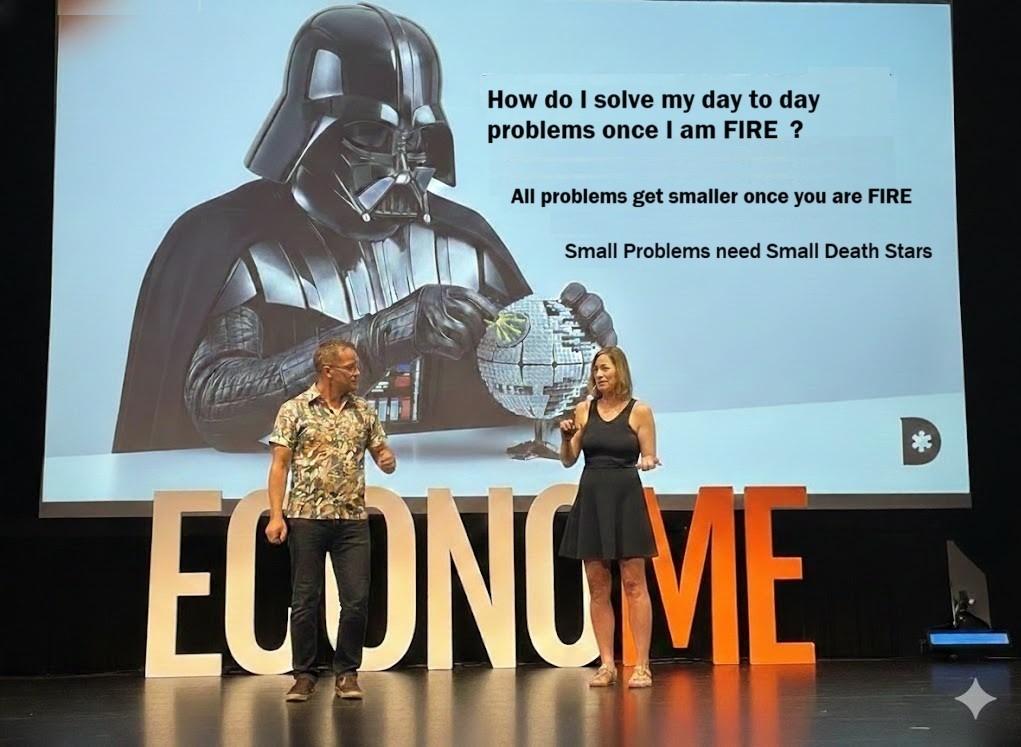
Using Morgan Housel’s opening theory, Vader—the investor who experienced the complete destruction of the telecom equipment sector—picks the toilet paper company. If you are Mr 1500 Days, Carl, who has great tech investing experience, you pick the AI companies.
We both make the decisions based upon what has happened to us before. Of course, Carl does like to experience good bowel movements, so I could be wrong on what he would buy. Maybe he goes high-tech on the toilet paper and goes all-in on an A.I. Bidet company.
It is easy to see why we invest the way we do. Whatever investing style you succeed with is really hard to get away from. The same goes for your failures. Kudos to the ones who learn and adapt over the years.
What is the best way to invest? I can’t tell you that. No one can. I only have my experience to go on. My conclusion?
I’m loading up on toilet paper.








 vaderonfire.com
Leave a comment